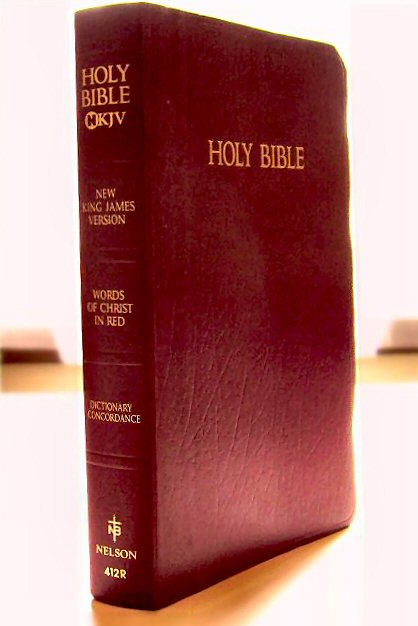
Thomas Nelson gathers a team (≈130 scholars, church leaders, and lay readers) to update the KJV while preserving its cadence and literary beauty. BibleGateway: NKJV Version Information
Full NKJV (OT+NT) appears; translation goal described as a faithful update to the KJV in contemporary English. Overview ·
Official timeline
1984 — Minor revision.
Publisher issues a light update for accuracy, clarity, and consistency; typeset widely from 1985 forward. Revision note
Translation Philosophy & Textual Basis
Approach:Complete equivalence (a word-for-word, formal-correspondence approach that aims to preserve all information while using natural contemporary English).
Old Testament: Based primarily on the Masoretic Text (notably Biblia Hebraica Stuttgartensia), with attention to textual and linguistic data.
New Testament: Translated from the traditional Greek Textus Receptus; extensive marginal notes indicate significant variants from the Nestle-Aland/UBS (critical text) and the Majority/Byzantine tradition, allowing readers to evaluate differences.
The New King James Version, commonly abbreviated NKJV, occupies a distinctive place in the history of the English Bible. Published in complete form in 1982 by Thomas Nelson, it was created for readers who valued the theological vocabulary, cadence, and literary inheritance of the King James Version but who also recognized that English had changed substantially since the seventeenth century. Rather than abandoning the King James tradition, the NKJV project attempted to renew it: to translate the Hebrew, Aramaic, and Greek Scriptures into contemporary English while preserving, wherever possible, the dignity, rhythm, familiar terminology, and ecclesiastical character associated with the KJV.
The project was commissioned in 1975. According to publisher summaries, approximately 130 Bible scholars, church leaders, editors, and lay readers participated over a seven-year period. The New Testament appeared in 1979, the Psalms followed in 1980, and the complete Bible was published in 1982. A minor revision followed in 1984. The result was neither a simple spelling update of the King James Bible nor a wholly independent modern translation. It was a fresh translation produced in conscious continuity with the KJV tradition, using a formal or “complete equivalence” philosophy and retaining the traditional textual base of the KJV in the New Testament while openly noting significant readings found in other Greek textual traditions.
The King James Heritage Behind the NKJV
To understand why the NKJV was created, it is necessary first to understand the extraordinary cultural position of the King James Version. First published in 1611, the KJV became the dominant English Bible across much of the Protestant world and remained deeply embedded in English-speaking Christianity for centuries. Its language shaped worship, preaching, hymnody, devotional writing, political rhetoric, and literature. Expressions derived from or popularized by the KJV became part of ordinary English speech, and its cadences acquired an almost liturgical familiarity even among people who did not attend church regularly.
That success also created a problem for later generations. The KJV was written in an early seventeenth-century form of English. Some words disappeared from common usage, others changed meaning, and grammatical constructions that had once sounded natural gradually became archaic. Pronouns such as “thee,” “thou,” “ye,” and “thy,” along with verb forms such as “hast,” “doth,” “saith,” and “art,” increasingly marked the KJV as belonging to another linguistic era. In some places the old vocabulary remained beautiful but unfamiliar; in others, a word that remained in use had acquired a different meaning, creating the possibility that a modern reader could misunderstand a verse while believing that the word was familiar.
Twentieth-century Bible translation therefore faced a recurring question: could the strengths of the King James tradition be preserved without requiring readers to master Jacobean English? Many modern translations answered by beginning from a different stylistic and textual starting point. The NKJV took another path. It accepted the premise that the KJV represented a valuable English Bible tradition worth conserving, but it treated that tradition as something that could be renewed rather than frozen.
This helps explain why the NKJV is best understood as both conservative and revisionary. It is conservative in literary instinct, theological vocabulary, and its commitment to continuity with the traditional English Bible. It is revisionary in grammar, vocabulary, punctuation, textual annotation, and the direct re-examination of the Hebrew, Aramaic, and Greek sources. Its translators did not merely replace “thee” with “you.” They were charged with producing a complete modern translation that could stand on its own while still sounding recognizably connected to the King James family.
The 1975 Commission
Thomas Nelson commissioned the New King James Version project in 1975. Publisher histories describe the undertaking as involving roughly 130 contributors drawn from biblical scholarship, the church, and Christian readership. That broad participation was significant. Bible translation is never only a matter of substituting one word for another. It requires decisions about grammar, syntax, textual variants, literary style, theological vocabulary, consistency, public readability, and the expectations of communities that will use the finished work in worship and study. The NKJV therefore involved multiple layers of translation, editorial review, and stylistic evaluation.
The project’s central purpose was clear: preserve what its editors regarded as the accuracy, authority, and beauty of the King James tradition while making the English understandable to contemporary readers. The challenge was unusually delicate. A translation that modernized too aggressively could lose the familiar cadence that had motivated the project. A translation that changed too little could leave readers with the very linguistic obstacles the project was designed to remove. The NKJV had to occupy the narrow ground between preservation and renewal.
Arthur L. Farstad became one of the most important figures in explaining and defending the work. As Executive Editor, Farstad later described the project in The New King James Version: In the Great Tradition. His account presents the NKJV not as a rejection of earlier English Bibles but as an attempt to continue a translation lineage. The title itself is revealing: the translators understood their work as taking place “in the great tradition,” not as an effort to erase it.
A Translation, Not Merely a Modernized KJV
The NKJV is sometimes described casually as the King James Bible with the archaic words removed. That description is too simple. The NKJV certainly modernizes the English of the KJV, but its editors also returned to the biblical languages and reconsidered the translation in light of Hebrew, Aramaic, and Greek grammar and vocabulary. The project was therefore a translation effort conducted with the KJV constantly in view, rather than a mechanical editing exercise performed only on the English text.
This distinction matters because English changes do not always map neatly onto the source languages. A seventeenth-century sentence may contain an idiom that cannot simply be modernized word by word. A term that once had a broad range of meanings may now communicate only one of them. A grammatical relationship may be clearer in modern English if the word order changes. At the same time, some traditional biblical terms remain useful precisely because they carry theological meaning built up through centuries of Christian use. The NKJV translators therefore had to decide, repeatedly, when to preserve, when to clarify, and when to recast.
The result often retains the sentence structure and solemnity familiar to KJV readers while eliminating forms that had become barriers to comprehension. The NKJV does not generally sound colloquial. Its language remains elevated, particularly in poetry, prophecy, prayer, and formal discourse. This was intentional. The translators sought modern English without reducing Scripture to the register of ordinary conversation.
“Complete Equivalence” and the Philosophy of Translation
The NKJV’s preface describes its approach in terms commonly summarized as complete equivalence. In contemporary discussions of Bible translation, the approach is usually placed on the formal-equivalence side of the spectrum. The goal is to preserve as much of the information and structure of the original language as English reasonably allows, while still producing intelligible English prose and poetry.
No translation can reproduce Hebrew or Greek structure perfectly. The languages differ too greatly in syntax, idiom, verbal systems, word order, and semantic range. A strictly mechanical correspondence would often be misleading or unreadable. The NKJV’s method therefore attempts close correspondence without pretending that translation can avoid interpretation. Where the source language requires an English adjustment, the translators aim to make that adjustment carefully and conservatively.
This approach helps explain why the NKJV became popular in churches and study environments that wanted a relatively literal translation but did not want to retain every feature of seventeenth-century English. It also explains why readers moving from the KJV to the NKJV often recognize familiar rhythms and phrases. Continuity was not an accidental by-product; it was one of the translation’s governing aims.
Modernizing the Language
The most immediately visible difference between the KJV and NKJV is linguistic modernization. The second-person pronouns and archaic verb endings of the KJV are generally replaced by contemporary forms. Obsolete or misleading vocabulary is updated. Punctuation is modernized, and sentence structure is adjusted where necessary for clarity. Yet the translation often resists unnecessary paraphrase. Familiar theological words are frequently retained when they remain intelligible and useful.
This balance gave the NKJV a recognizable voice. It is modern but not casual; formal but not deliberately antique. In narrative passages it tends to read more smoothly than the KJV to a contemporary audience, while poetry and prophetic literature retain a heightened literary register. In public reading, this produces a cadence that many readers consider closer to the historic English Bible tradition than translations written in more conversational forms of English.
Another characteristic is the retention of traditional capitalization practices in many editions, particularly references to deity. Such conventions are editorial rather than features of the original biblical manuscripts, but they contribute to the devotional presentation associated with many NKJV printings. Different editions and international print traditions have sometimes varied in details of capitalization and presentation, yet the general stylistic identity remains clear.
The Old Testament Text
The NKJV Old Testament is based primarily on the Hebrew Masoretic tradition, the textual stream that also stands behind the Old Testament of the King James Version. By the twentieth century, however, translators had access to far more developed scholarly editions, linguistic research, ancient versions, manuscript discoveries, and comparative data than were available in 1611. The NKJV project could therefore remain rooted in the traditional Hebrew text while also consulting the broader body of textual evidence.
The page currently maintained by Living Word Bibles correctly identifies Biblia Hebraica Stuttgartensia as a principal scholarly form of the Masoretic Text used in the period. That edition is based on the Leningrad Codex, the earliest complete manuscript of the Hebrew Bible in the Tiberian Masoretic tradition. Modern scholarship also had access to the Dead Sea Scrolls, the Septuagint, the Samaritan Pentateuch, the Vulgate, Syriac traditions, and other witnesses that could illuminate difficult passages.
The NKJV did not simply replace the Masoretic text whenever another witness offered a different reading. Its fundamental orientation remained conservative and Masoretic. Yet its notes and translation decisions reflect awareness that the textual history of the Old Testament is broader than any single medieval manuscript. This combination—traditional base text with attention to other evidence—parallels the translation’s wider strategy of continuity accompanied by scholarly transparency.
The New Testament and the Textus Receptus
The textual basis of the NKJV New Testament is one of its most distinctive features. The translation follows the traditional Greek text associated with the Textus Receptus, the printed Greek tradition that substantially underlies the New Testament of the King James Version. This decision made the NKJV unusual among major late-twentieth-century English translations, most of which translated from modern critical editions of the Greek New Testament.
The term Textus Receptus refers not to one ancient manuscript but to a family of early printed Greek New Testament editions produced after the invention of printing. Editions associated with Erasmus, Robert Estienne, Theodore Beza, and the Elzevir printers contributed to the tradition. The KJV translators worked from forms of this printed Greek text along with other resources available to them. By the twentieth century, many significantly earlier Greek manuscripts had become available, and textual criticism had developed methods for comparing the enormous manuscript tradition of the New Testament.
The NKJV’s response to that changed scholarly environment was noteworthy. It retained the traditional text in the body of the translation but used marginal notes to identify important differences found in other textual traditions. The notes commonly distinguish readings associated with the modern critical text and readings associated with the Majority or Byzantine tradition. In many NKJV editions these are identified through abbreviations such as NU-Text and M-Text.
This means that the NKJV can serve two purposes at once. A reader who wishes to read a translation based on the traditional Greek text can do so in the main text. At the same time, that reader is repeatedly alerted to places where other major Greek textual traditions differ. For students without access to a full Greek critical apparatus, these notes provide a practical introduction to textual variation.
Why the Variant Notes Matter
The NKJV’s variant notes are not merely technical decorations. They reflect one of the central realities of biblical textual history: ancient manuscripts sometimes differ. Most differences are small—spelling, word order, the presence or absence of a word, or other variations that do not alter Christian doctrine. Some variants are more substantial and have therefore become familiar to readers of study Bibles and modern translations.
By retaining the traditional reading in the body while identifying significant alternatives in the margin, the NKJV invites readers to see textual criticism rather than hiding it. This is especially significant because debates over the Textus Receptus, Majority Text, and modern critical text can become highly polarized. The NKJV itself is more transparent than many popular descriptions of it: it follows one textual tradition while acknowledging others.
Farstad’s involvement gives this feature additional historical interest. He was associated not only with the NKJV but also with work on the Majority Text tradition. His own textual preferences were not identical to every reading of the Textus Receptus, yet the NKJV project maintained continuity with the KJV’s traditional base text. The margin became a place where that wider textual conversation could be represented without changing the basic identity of the translation.
The Committee Process
Large Bible translations are collaborative works, and the NKJV was no exception. The involvement of approximately 130 participants helped prevent the Bible from becoming the stylistic product of one translator. Scholars could evaluate Hebrew and Greek, editors could assess English style and consistency, and church readers could consider how the translation sounded in teaching, worship, and devotional use.
Such a process necessarily involves negotiation. A translation may be accurate in a narrow lexical sense yet awkward when read aloud. A phrase may be familiar to generations of Christians but no longer communicate the meaning it once did. A literal rendering may obscure an idiom; an idiomatic rendering may seem to move too far from the wording of the original. The NKJV’s final form represents thousands of decisions made within that tension.
The project also had to decide how much of the KJV’s recognizable language should be retained. In famous passages, unnecessary alterations could alienate readers without improving accuracy. In less familiar passages, inherited wording could sometimes remain simply because it was traditional, even when better contemporary English was available. The translators’ task was therefore not to modernize at all costs, but to determine where modernization genuinely served understanding.
The Staged Publication: 1979, 1980, and 1982
The NKJV did not appear all at once. The New Testament was released in 1979, giving readers their first substantial experience of the new translation. The Psalms followed in 1980. The complete Old and New Testaments were published in 1982. This staged release allowed the translation to enter churches, homes, and bookstores before the full project had reached completion.
The 1982 publication established the NKJV as a complete Bible and remains the principal copyright date associated with the translation. A minor revision was completed in 1984. Later printings and editions introduced the NKJV into an enormous range of formats: pew Bibles, reference Bibles, study Bibles, devotional editions, children’s editions, large-print editions, compact Bibles, electronic texts, mobile apps, and audio editions.
The variety of formats helped move the NKJV beyond the narrow category of a “KJV update.” It became a translation used in its own right. Churches adopted it for preaching and public reading. Bible teachers used its textual notes. Readers who had grown up with the KJV used it as a bridge into contemporary English, while readers with no prior attachment to the KJV encountered it simply as a formal modern translation.
Arthur L. Farstad and the NKJV’s Intellectual Identity
Arthur L. Farstad is especially important to the NKJV’s history because he provided a detailed insider account of the translation’s goals and process. His book The New King James Version: In the Great Tradition describes a project shaped by three concerns that may be summarized as accuracy, beauty, and completeness. Those categories help explain the NKJV better than the label “modernized KJV” does.
Accuracy concerned fidelity to the Hebrew, Aramaic, and Greek Scriptures. Beauty concerned the literary and oral character inherited from the KJV. Completeness concerned the attempt to carry the information of the original text into English without unnecessary omission or paraphrase. These goals could conflict in individual passages, which is precisely why a committee process was necessary.
Farstad also represents an important bridge between translation and textual criticism. His scholarly interests in the Byzantine and Majority Text traditions informed his appreciation for textual history, even though the NKJV’s main New Testament text remained the Textus Receptus. The translation’s marginal apparatus can therefore be viewed as one of its most educational features: it makes readers aware that the printed English Bible stands at the end of a long manuscript and editorial history.
Literary Style and Public Reading
The KJV was created in part to be read aloud in church, and its long public life gave English-speaking Christians an ear for its rhythm. The NKJV consciously preserves much of that rhetorical character. Parallel structures remain audible. Poetry retains formality. Prophetic passages often retain a sense of grandeur. The Gospels and Epistles sound more contemporary than in the KJV, yet they generally avoid the rapidly changing vocabulary of everyday slang.
This stylistic conservatism can be an advantage in worship. Liturgical and public reading require language that can bear repetition. A phrase heard every week or memorized over years functions differently from a sentence designed merely to transmit information once. The NKJV’s elevated register gives it durability and helps explain its continued use decades after publication.
At the same time, style is partly a matter of reader expectation. Some readers find the NKJV elegant and reverent; others prefer the plainer syntax of newer translations. Some value continuity with the KJV; others see no need to preserve a seventeenth-century English inheritance. The NKJV’s identity is strongest when these preferences are stated openly: it is intentionally a modern Bible in the King James tradition.
The NKJV in the Landscape of Modern English Bibles
The late twentieth century was a period of extraordinary activity in English Bible translation. The Revised Standard Version, New American Standard Bible, New International Version, New Revised Standard Version, and other translations represented different approaches to textual criticism, translation philosophy, denominational breadth, and English style. The NKJV entered that crowded landscape with a clearly differentiated mission.
Unlike translations whose purpose was to create a new English rendering from a modern critical text, the NKJV deliberately linked itself to the KJV. Unlike simple KJV modernizations, it involved a major scholarly translation project and a systematic textual apparatus. Unlike paraphrases, it sought close formal correspondence. These features gave it a recognizable niche: contemporary English for readers who wanted substantial continuity with the historic Authorized Version.
This position also explains some of the debates surrounding the NKJV. Advocates of the exclusive use of the KJV sometimes object that any revision abandons an authoritative English tradition. At the other end, readers committed to modern critical editions may prefer a translation whose main text follows those editions rather than the Textus Receptus. The NKJV occupies the space between those positions. Its continuing popularity suggests that a significant number of readers value precisely that middle position.
Reception in Churches and Bible Study
The NKJV found a substantial readership among evangelical, charismatic, Baptist, independent, and other Protestant communities, though its use is not limited to any one denomination. Its suitability for preaching is often connected to its combination of formality and readability. Pastors familiar with KJV phrasing can move to the NKJV without losing every familiar expression; congregations can follow public readings without having to interpret obsolete grammar.
Study editions have also amplified the translation’s influence. Because Thomas Nelson controls the NKJV, the text has appeared in numerous branded study Bibles, reference systems, devotional products, and specialty editions. These publishing ecosystems matter. A Bible translation becomes culturally significant not only because of its wording but because of the tools, teachers, churches, and reading practices that form around it.
The NKJV’s marginal textual notes are particularly valuable in study contexts. Readers encounter not only cross-references and explanatory notes but also indications of differences among Greek textual traditions. This can prompt deeper study and help readers understand why English translations occasionally differ from one another even when translators are working conscientiously.
Continuity and Difference with the KJV
The relationship between the NKJV and KJV is best described as family resemblance rather than identity. The NKJV preserves many recognizable expressions, but it is not the 1611 text with updated spelling. It removes obsolete pronouns, adjusts grammar, updates vocabulary, revises punctuation, makes new translation judgments, and presents textual information unavailable to the original KJV translators.
The two translations also exist in different historical worlds. The KJV emerged from the religious politics of early Stuart England, the ecclesiastical structure of the Church of England, and the manuscript resources of the early seventeenth century. The NKJV emerged from twentieth-century evangelical publishing, modern biblical scholarship, global English readership, mass-market printing, electronic media, and a religious environment in which readers could choose among many major English translations.
Yet continuity is real. Both translations belong to the long English Bible tradition shaped by Tyndale and his successors. Both value formal biblical diction. Both use the traditional New Testament textual line in their main text. Both have been adopted for memorization and public reading. The NKJV’s success depends in large part on readers hearing that continuity even while recognizing that the English has changed.
Theological Vocabulary
One reason formal translations remain valuable is that biblical theology often depends on patterns of recurring terminology. Words associated with covenant, righteousness, justification, sanctification, redemption, atonement, grace, faith, flesh, spirit, glory, and kingdom carry relationships across books and genres. A translation that varies such terms too freely can make those relationships harder to see.
The NKJV generally retains established theological vocabulary when the terms remain meaningful in modern English. This does not mean that every traditional rendering is preserved, nor that the translation avoids all interpretive choices. It means that continuity of terminology is treated as a positive value rather than an obstacle to be eliminated. For pastors, teachers, and readers tracing themes across Scripture, this can be especially useful.
Proper Names, Poetry, and the Shape of the Text
Bible translation also involves editorial decisions beyond individual words. Names can be transliterated differently; poetry can be formatted as verse or prose; quotations can be marked with modern punctuation; paragraph divisions can affect how readers perceive arguments; capitalization can signal editorial interpretation. The NKJV participates fully in this modern presentation of the biblical text.
Poetic passages are formatted to reveal parallelism and literary structure more clearly than older continuous-prose Bible printing often did. Paragraphing guides the reader through discourse. Headings in many editions help navigation, though such headings are editorial aids rather than part of the biblical text itself. Footnotes distinguish translation notes from textual variants and cross-references.
These elements show why the physical and digital design of a Bible matters. Scripture reaches readers not as an abstract stream of words but through typography, layout, navigation, notes, and visual hierarchy. The NKJV’s long publishing history has allowed it to appear in both traditional and highly contemporary designs while retaining the same translation text.
Copyright and Permissions
Unlike the King James Version in the United States, the New King James Version is copyrighted. The copyright is held by Thomas Nelson, part of HarperCollins Christian Publishing. BibleGateway’s current NKJV information page states that the NKJV text may be quoted without written permission within specified limits, including limits on the number of verses and the proportion of a work represented by NKJV quotations. Uses beyond the stated gratis guidelines require permission from the rights holder.
This legal status affects publishers, churches, websites, apps, authors, and ministries that reproduce the translation. It does not prevent ordinary reading, study, or normal quotation within the publisher’s policies, but it does mean that digital distribution of the complete NKJV text cannot be treated like distribution of a public-domain translation. Living Word Bibles therefore presents the NKJV with the appropriate copyright acknowledgment and directs readers to authorized reading resources.
The NKJV in the Digital Era
When the complete NKJV appeared in 1982, personal computing was in its infancy and the modern web did not exist. Today the translation is read on phones, tablets, websites, e-readers, study platforms, and audio services. This shift has changed the way readers encounter the textual features that were once confined to a printed margin. Variant notes can appear as pop-ups; cross-references become hyperlinks; searches can locate every occurrence of a word instantly; parallel translations can be placed side by side on a screen.
Digital reading also creates new challenges. The very ease of switching translations can cause readers to overlook the distinctive philosophy behind each one. A verse may appear as a single line in an app without the preface, textual notes, or editorial explanations that help the reader understand why it is worded as it is. For the NKJV, the preface and textual notes are particularly important because they explain the translation’s relationship to the KJV, the Masoretic Text, the Textus Receptus, the Majority Text, and modern critical editions.
For that reason, serious readers benefit from treating a Bible translation as more than a set of verse results returned by a search engine. Every translation has a history, a textual basis, a philosophy, and an editorial method. The NKJV is especially instructive because those elements are visible in the translation itself.
Criticism and Debate
No major Bible translation escapes criticism, and the NKJV has been evaluated from several directions. Some KJV-only advocates argue that modernizing the Authorized Version is unnecessary or that the NKJV’s marginal references to other Greek texts undermine confidence in the traditional text. Some proponents of modern critical texts argue that the NKJV should have adopted those critical editions in its main New Testament text rather than preserving the Textus Receptus.
These criticisms arise from different assumptions, and they reveal the unusual position the NKJV occupies. Its main text is traditional enough to disappoint readers who want a critical-text translation, while its notes are textually expansive enough to trouble readers who want the Textus Receptus presented without alternatives. Yet what critics see as tension is also one of the NKJV’s defining characteristics: continuity in the main text combined with disclosure in the margins.
There are also ordinary translation disagreements. Scholars can dispute whether a particular Hebrew or Greek phrase has been rendered most accurately, whether a familiar KJV expression should have been retained, or whether a modern wording goes far enough. Such disagreement is normal in translation. The existence of multiple responsible English Bibles reflects the fact that no single translation can reproduce every feature of the original languages at once.
The NKJV as a Bridge Translation
Perhaps the most useful way to understand the NKJV is as a bridge. It connects readers formed by the KJV with contemporary English. It connects the early modern English Bible tradition with twentieth-century textual scholarship. It connects a traditional New Testament base text with marginal awareness of the Majority and critical texts. It connects formal translation with readability.
A bridge is valuable because it allows movement in both directions. A reader of the NKJV can approach the KJV and recognize much of its syntax and vocabulary. The same reader can compare the NKJV’s notes with translations based on modern critical editions and see where textual differences arise. Students can encounter traditional theological language without the full burden of Jacobean grammar.
This bridging function helps explain the NKJV’s endurance. It is not simply a historical artifact from the 1980s. It continues to address a real need among readers who want a Bible that sounds dignified and familiar without sounding intentionally archaic.
Why the NKJV Still Matters
More than four decades after the publication of the complete Bible, the NKJV remains widely read because its original problem has not disappeared. English-speaking Christians still negotiate the relationship between inherited language and contemporary communication. Churches still ask whether a translation should sound like ordinary speech or sacred literature. Students still ask why manuscripts differ. Readers still want to know whether newer English necessarily means looser translation.
The NKJV offers one coherent answer. Scripture can be translated into modern English without abandoning formal correspondence. The literary memory of the King James Bible can be respected without requiring readers to use seventeenth-century pronouns and verbs. A traditional Greek New Testament can be used in the main text while other textual traditions are identified openly in notes. Modern publishing can serve continuity rather than requiring novelty for its own sake.
That does not make the NKJV the only legitimate English Bible, nor was that the premise of the project. Its significance lies in the particular solution it offers. It is a Bible created at the meeting point of inheritance and revision, tradition and scholarship, liturgical dignity and contemporary readability.
Legacy
The New King James Version belongs to a centuries-long story of English Bible translation. Tyndale’s pioneering work, the Geneva Bible, the Bishops’ Bible, the King James Version, later revisions, and modern translations all testify to the continuing effort to communicate ancient Scripture faithfully in living English. The NKJV contributes to that history by demonstrating that revision can itself be an act of preservation.
Its translators did not preserve the KJV by leaving every word untouched. They preserved what they believed to be its enduring strengths by distinguishing those strengths from features that belonged primarily to an older stage of the English language. The project’s success can be measured not only in sales or editions but in the fact that millions of readers came to regard the NKJV as a Bible with its own recognizable voice.
For readers who love the King James tradition, the NKJV remains one of the most important modern descendants of that heritage. For students of textual history, its variant notes provide a useful window into competing Greek traditions. For pastors and churches, its formal but accessible style continues to work well in public proclamation. And for historians of the English Bible, the NKJV represents a major twentieth-century attempt to answer a perennial question: how can an inherited translation tradition remain alive when the language around it changes?
The answer offered by the New King James Version is neither to abandon tradition nor to preserve it under glass. It is to translate again—carefully, conservatively, and transparently—so that an old inheritance can continue to speak in the English of a new generation.
Bibliography
Primary and Publisher Sources
New King James Version. “Preface to the New King James Version.” Thomas Nelson, 1982. Hosted by Blue Letter Bible. The preface is the translation committee’s primary statement of the NKJV’s “complete equivalence” method, King James heritage, textual basis, and treatment of textual variants. Read the NKJV Preface.
Farstad, Arthur L. The New King James Version: In the Great Tradition. Nashville: Thomas Nelson, 1989. An insider history by the NKJV Executive Editor, organized around the project’s concerns for accuracy, beauty, and completeness.
Thomas Nelson. Holy Bible, New King James Version. Nashville: Thomas Nelson, 1982. See especially the NKJV preface for the translators’ account of method, textual basis, and editorial conventions.
BibleGateway. “New King James Version (NKJV) — Version Information.” Publisher information describing the 1975 commission, the approximately 130 participants, seven-year process, and current quotation policy.
Thomas Nelson Bibles. “NKJV History.” Publisher history of the New Testament, Psalms, and complete Bible publication sequence.
Textual and Historical Reference Works
Hodges, Zane C., and Arthur L. Farstad, eds. The Greek New Testament According to the Majority Text. Nashville: Thomas Nelson, 1982. Important for understanding Farstad’s relationship to the Majority Text tradition.
Marlowe, Michael D. “New King James Version.” Bible-Researcher.com. A detailed independent overview of the project, personnel, textual basis, and reception.
Metzger, Bruce M., and Bart D. Ehrman. The Text of the New Testament: Its Transmission, Corruption, and Restoration. 4th ed. New York: Oxford University Press, 2005. General scholarly background for the manuscript and textual-critical questions reflected in NKJV marginal notes.
Tov, Emanuel. Textual Criticism of the Hebrew Bible. 3rd ed. Minneapolis: Fortress Press, 2012. Standard scholarly background for the Hebrew textual tradition and the evidence considered by modern Old Testament translators.
Norton, David. A Textual History of the King James Bible. Cambridge: Cambridge University Press, 2005. Essential context for the English textual tradition to which the NKJV consciously relates itself.
Image Source
“New King James Version (1982).jpg.” Wikimedia Commons. The image depicts a 1982 New King James Version; the derivative image is identified by Wikimedia Commons as released into the public domain.