Introduction: More Than a “Bible with Extra Books”
The expression Ethiopian Bible commonly refers to the biblical tradition of the Ethiopian Orthodox Tewahedo Church and, in closely related form, the Eritrean Orthodox Tewahedo Church. It is one of Christianity’s oldest continuously transmitted scriptural traditions. Its classical language is Geʿez, an ancient Semitic language of the Horn of Africa that remains the principal liturgical language of the Ethiopian Church. The tradition is famous for its wider canon, but a count of books alone cannot explain its importance. The Ethiopian Bible is also a history of translation from Greek into an African language, of parchment manuscripts copied and interpreted in monasteries, of Scripture woven into worship, and of a church preserving works that disappeared in complete form from most other Christian communities.1
Living Word Bibles presents the complete 88-book Ethiopian Bible. The edition includes the familiar sixty-six books together with twenty-two additional complete books from the Ethiopian biblical tradition. Some church and scholarly lists reach different totals by combining continuations or related writings under shared headings; those are different counting conventions, not evidence that the Living Word Bibles edition is missing books. Ethiopian lists have never been uniform in how every writing is grouped, divided, or named.2
What makes this tradition extraordinary is not a sensational claim that every other church removed the same set of books. Rather, Ethiopia received the Scriptures within its own ancient Christian history and preserved a canon whose boundaries do not precisely duplicate Protestant, Roman Catholic, Eastern Orthodox, Coptic, or Syriac collections. The result is a distinct Christian library. It shares the four Gospels, Acts, apostolic letters, and most Old Testament books known around the world, while also receiving Enoch, Jubilees, the three books of Meqabyan, and other writings with a status or arrangement particular to the Tewahedo tradition. To understand it well is to respect both what Ethiopia shares with the worldwide Church and what it has uniquely guarded.
Christianity in Aksum and the World of the First Translations
The historical setting of the Ethiopian Bible begins with the kingdom of Aksum, a major power centered in the northern Ethiopian and Eritrean highlands. Aksum participated in trade networks linking the Red Sea, the Nile Valley, the Mediterranean, Arabia, and the Indian Ocean. Christianity became established at the royal court during the fourth century, traditionally through the ministry of Frumentius. According to the church historian Rufinus, Frumentius and his companion Aedesius reached the Aksumite court after surviving a maritime disaster. Frumentius later traveled to Alexandria, where Athanasius consecrated him bishop for Aksum. Ethiopian tradition remembers him as Abba Salama, “Father of Peace.” Coinage issued under King Ezana provides material evidence for the kingdom’s adoption of Christian symbols in this era.3
The conversion of a ruler did not instantly create a complete Geʿez Bible, but it established the ecclesial environment in which biblical translation could flourish. Christian teachers, clergy, merchants, and monks moved through connections with Egypt and the eastern Mediterranean. Greek had an important place in Aksumite inscriptions and international exchange; Geʿez served the kingdom and increasingly became the language into which Christian teaching was translated. Ethiopian tradition also associates a later group called the Nine Saints with the growth of monasticism and translation. Modern historians debate the details and dates attached to individual saints, but the larger picture is clear: late antique Ethiopia was not isolated. Its Christianity emerged within networks that joined African, Mediterranean, and Near Eastern Christian worlds.
Translations of biblical books into Geʿez were produced over time rather than by one committee whose proceedings survive. The oldest recoverable form of much of the Ethiopic Old Testament was translated predominantly from Greek, making it one of the ancient “daughter versions” of the Septuagint. The New Testament likewise reflects Greek source texts. This does not mean that the entire Bible was translated by one person or that every book has the same textual history. Linguistic evidence reveals different translators, methods, and degrees of competence. Some renderings are highly literal; others show freer interpretation. Later copies sometimes reflect revision against Arabic versions or other textual traditions. Michael A. Knibb’s work on the Ethiopic Old Testament emphasizes both the fundamental Greek basis of the early translation and the layered revisions visible across books and manuscripts.4
Geʿez: The Scriptural Language of the Ethiopian Church
Geʿez belongs to the Ethiopic branch of the Semitic language family. It is written in a distinctive script in which the shape of a consonantal sign changes to indicate its accompanying vowel. Although Geʿez ceased to be an ordinary spoken vernacular centuries ago, it did not become a dead language in the simple sense. It continued as a language of Scripture, worship, theology, hymnody, royal chronicles, monastic education, law, and learned commentary. Its relationship to Ethiopian Christianity is sometimes compared with Latin in Western Christianity, Coptic in the Coptic Church, or Church Slavonic in Slavic Orthodox traditions, though every comparison has limits.
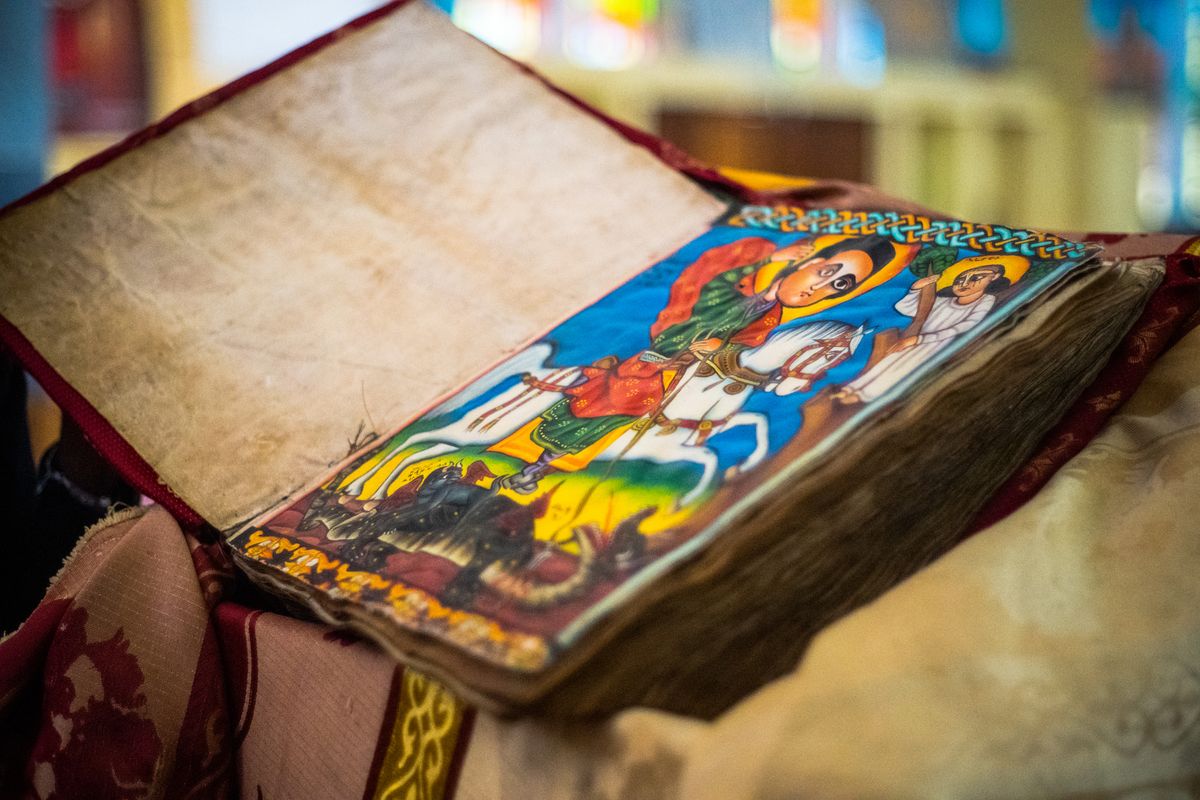
Calling the Ethiopian Bible a “Geʿez Bible” therefore identifies more than its alphabet. The translation helped create a Christian literary culture. Biblical vocabulary shaped Ethiopian prayer and theology, while biblical stories informed visual art, kingship, fasting, feast days, preaching, and devotional imagination. Manuscripts often place text, ornament, canon tables, portraits of evangelists, and other images within a unified sacred object. The Bible was heard in liturgy and studied through traditional interpretation as well as privately read. In the Ethiopian Orthodox system of education, learned teachers transmitted Geʿez texts and their meanings through disciplined oral and written practices.
Modern readers also encounter Scripture in Amharic, Tigrinya, Oromo, and other languages. Translation into contemporary languages does not erase the authority of Geʿez; it extends access while the ancient text retains liturgical and scholarly importance. Printed editions, audio, and digital tools now stand beside handwritten codices. This layered multilingual life cautions against imagining “the Ethiopian Bible” as one antique artifact frozen in the distant past. It is a textual tradition with ancient witnesses and modern readers.
The Garima Gospels and Ethiopia’s Manuscript Heritage
The Garima Gospels are among the most remarkable surviving witnesses to early Ethiopian Christianity. Preserved at the monastery of Abba Garima in northern Ethiopia, the manuscripts contain the four canonical Gospels in Geʿez along with richly colored decoration, evangelist portraits, and canon tables. Radiocarbon analysis has assigned the ancient volumes to the late fifth through early seventh centuries. The Ethiopian Heritage Fund describes them as among the earliest surviving manuscripts illustrated with Christian images, while Oxford scholars identify them as the earliest surviving Ethiopian Gospel books and the earliest physical witnesses to the translation of the Greek four-Gospel text into Geʿez.5
Their importance is both textual and artistic. Canon tables—systems associated with Eusebius of Caesarea for locating parallel Gospel passages—connect the books with the broader late antique culture of Gospel production. Their portraits and architectural decoration reveal artists working within an international Christian visual world while producing objects rooted in Ethiopia. The manuscripts demonstrate that sophisticated bookmaking, biblical translation, and Christian art had taken deep root in the Horn of Africa at an early date.
The Garima books should not be mislabeled as a complete “Ethiopian Bible.” They are Gospel manuscripts, not a complete eighty-eight-book codex. Nor do they prove that every later canonical boundary was already fixed when they were made. What they do prove is powerful enough: an ancient Geʿez Gospel tradition existed in material form near the beginnings of Christian manuscript illumination. Their survival at a living monastery also reminds modern observers that sacred manuscripts are not only museum objects. They belong to communities that have prayed with, protected, repaired, and venerated them across generations.
Most Ethiopian manuscripts are younger than the Garima Gospels, and many early witnesses were lost through war, fire, environmental damage, reuse, and ordinary decay. Surviving codices nevertheless preserve a vast Christian literature. Parchment was prepared from animal skin; texts were copied by hand with locally made inks; wooden boards and leather protected the leaves; painted images and ornamental frames could transform a Gospel book into a work of sacred art. Variations among manuscripts are important to textual critics, who compare readings to reconstruct older forms of the Geʿez translation and the Greek texts behind it.
Why This Edition Contains Eighty-Eight Complete Books
The Living Word Bibles edition uses a transparent book-by-book count of eighty-eight complete books: the sixty-six books familiar from the Protestant Bible plus twenty-two additional books preserved or received within the wider Ethiopian tradition. Readers can review the published volume directly in The Complete Apocrypha of the Ethiopian Bible.6
Why, then, do some references use eighty-one? Roger W. Cowley’s influential study observed that the phrase “the 81 books” names one recognized corpus even though manuscript and printed lists vary. Gebre-Amanuel Mikre-Sellassie later explained the relationship between different lists and the ways Ethiopian sources reach that grouped total. Recent scholarship by Daniel Assefa and Bruk A. Asale likewise stresses that Ethiopian canonicity is best interpreted within the Church’s own history rather than forced into a single Western model of a closed printed table of contents. The difference between eighty-one and eighty-eight is therefore substantially a matter of how continuations and related writings are grouped and counted. Living Word Bibles counts every complete book presented in its edition, yielding eighty-eight.7
The Old Testament shares its central narrative, poetic, and prophetic books with other ancient churches but also includes important works outside most Western Bibles. Enoch and Jubilees are especially famous. The books called 1, 2, and 3 Meqabyan must not be confused with the Greek 1–4 Maccabees known from Catholic and Eastern Orthodox collections; similarity of English names does not imply identity of content. Other arrangements include the Prayer of Manasseh within Chronicles, multiple Ezra writings, and Jeremiah-related texts. Exact title forms vary when Geʿez names are transliterated or translated into English.
The broader New Testament reckoning begins with the same twenty-seven books received across most Christian traditions: the four Gospels, Acts, Pauline and Catholic Epistles, and Revelation. It then includes writings concerned with apostolic order, church discipline, covenantal instruction, and ecclesial life. The Ethiopic Clement is not simply the same text as the Greek or Latin work usually called 1 Clement, and the Ethiopic Didascalia must be distinguished from similarly named church-order works in other languages. These distinctions matter because commercial “complete Ethiopian Bible” products sometimes assemble English translations of unrelated texts under familiar names.
Distinctive Books of the Ethiopian Tradition
1 Enoch
An apocalyptic collection associated with Enoch, featuring the Watchers, heavenly journeys, judgment, wisdom, and visions. Its most complete ancient form survives in Geʿez.
Jubilees
A retelling of Genesis and part of Exodus organized through jubilees and sacred chronology, emphasizing covenant, calendar, law, angels, and Israel’s identity.
1–3 Meqabyan
Three Ethiopian works bearing a name related to “Maccabees” but differing from the Greek Maccabean books in characters, narrative, and theological emphasis.
Broader Canon Writings
Church-order and instructional texts, including Sinodos, books of Covenant, Ethiopic Clement, and the Ethiopic Didascalia, within a wider canonical reckoning.
Enoch
First Enoch is a composite Jewish apocalyptic work whose major sections emerged before and around the beginnings of Christianity. Fragments in Aramaic discovered among the Dead Sea Scrolls confirm that substantial portions circulated in Second Temple Judaism long before their Ethiopic transmission. The Epistle of Jude contains language closely corresponding to 1 Enoch 1:9, evidence that Enochic tradition was known to at least one New Testament author. Greek and other fragments survive, but the complete form on which modern translations depend was preserved in Geʿez manuscripts. Ethiopian Christianity therefore did not merely keep an exotic appendix; it transmitted the fullest witness to a work essential for studying ancient Jewish ideas about angels, evil, judgment, the righteous, and the heavenly world.8
The Ethiopian text is indispensable but must be studied historically. First Enoch was not originally composed in Geʿez as one book by the biblical patriarch. It is a collection with a complex literary history, translated from an earlier language through Greek. Textual critics compare the Ethiopic manuscripts with Aramaic and Greek fragments to evaluate readings. Within the Ethiopian Church, however, historical questions about composition exist alongside a canonical and devotional reception different from that of churches that classify Enoch as pseudepigrapha.
Jubilees
Jubilees revisits the stories from creation through Moses at Sinai, presenting history in periods of jubilees and weeks of years. It gives extended attention to the calendar, festivals, purity, covenant signs, angelic revelation, and the identity of Israel. Hebrew fragments from Qumran demonstrate the book’s Jewish antiquity. As with Enoch, the complete text survives through the Ethiopic version, although fragments and translations in other languages aid critical study. James C. VanderKam’s scholarship has been especially influential in establishing its text, historical setting, and relationship to Genesis, Exodus, and Second Temple Judaism.9
The Three Books of Meqabyan
English discussions frequently call these books “Ethiopian Maccabees,” which can cause confusion. The Ethiopian 1–3 Meqabyan are not translations of the Greek books centered on Mattathias, Judas Maccabeus, and the Hasmonean revolt. They contain different characters and narratives and emphasize fidelity to God, resistance to idolatry, judgment, resurrection, and moral perseverance. Their Geʿez title and their association with the canonical total belong to the Ethiopian tradition. Any English edition should clearly identify which texts it contains rather than treating all books called Maccabees or Meqabyan as interchangeable.
Church-Order Books in the Broader Canon
The broader canon is distinctive because it includes material that many Western readers would classify as apostolic church order rather than Bible. The four parts of Sinodos, two Books of Covenant, Ethiopic Clement, and the Ethiopic Didascalia concern doctrine, discipline, sacramental practice, clerical order, ethics, and communal life. Their inclusion illustrates a conception of authoritative Christian literature shaped by the Church’s worship and governance. It also explains why a “complete English Ethiopian Bible” is difficult to define: some of these texts remain poorly known, are not widely available in reliable English editions, or differ from works with similar titles elsewhere.
The Canon in Worship, Commentary, and Daily Christian Life
A canon is more than an inventory. Scripture lives through proclamation, prayer, fasting, festivals, preaching, memorization, art, and commentary. Ethiopian Orthodox worship is deeply biblical, drawing together Psalms, Gospel readings, apostolic texts, hymns, homilies, and ritual action. Gospel books receive special reverence as material signs of Christ’s word. Processions, liturgical reading, and the visual honor given to manuscripts express a theology in which Scripture is encountered by the worshiping community, not only analyzed as printed information.
Ethiopia also possesses a sophisticated interpretive tradition. The classical system often known as andemta joins a Geʿez text with Amharic explanation, grammatical observation, harmonization, stories, theological interpretation, and citations from other authorities. Teachers transmit not just a literal gloss but a received way of reading. Cowley’s studies of Ethiopian biblical interpretation show how written manuscripts and oral scholarship cooperate. A manuscript may preserve compact notes whose fullness becomes apparent only within the teaching tradition that accompanies them.10
This setting challenges two opposite errors. One is to romanticize Ethiopia as a sealed time capsule that preserved Christianity without development. Ethiopian texts have histories: they were copied, revised, commented upon, translated, printed, and debated. The other error is to judge the tradition only by how closely it resembles a modern Western study Bible. The Tewahedo Church’s canon, lectionary, liturgy, monastic learning, and interpretive methods form a coherent ecclesial world. Its differences deserve description before comparison.
Why Geʿez Manuscripts Matter to Textual Scholarship
Ancient translations are valuable to textual critics because they can preserve evidence for source texts older than most surviving manuscripts in the original language. The Ethiopic version is therefore studied not only as an Ethiopian achievement but also as a witness to Greek biblical traditions. The process requires caution. Scholars cannot mechanically translate a Geʿez sentence backward and assume that they have recovered the translator’s exact Greek exemplar. A reading may reflect ordinary Geʿez grammar, a translator’s interpretation, corruption during copying, or a medieval revision. Only comparison across multiple Ethiopic manuscripts, Greek witnesses, and other ancient versions can establish the most plausible history.
This work has consequences far beyond unusual canonical books. Geʿez manuscripts preserve witnesses to books shared by Christians everywhere, from Genesis and the Prophets to the Gospels and Pauline letters. Critical editors analyze recurring translation equivalents, word order, omissions, additions, and agreements with known Greek textual families. A consistent pattern may reveal the type of Greek text available to an early translator; an isolated divergence may be a later scribal accident. Ethiopic evidence thus participates in the same disciplined comparative work as Latin, Syriac, Coptic, Armenian, Georgian, and other ancient versions.12
For Enoch and Jubilees, the stakes are even more visible because Geʿez supplies the only complete textual form. Discoveries at Qumran did not make the Ethiopic witnesses obsolete. They confirmed the antiquity of these works and created new opportunities to compare the complete version with much older fragments. Agreements can illuminate the earlier text; differences may disclose translation, development, or transmission. Modern critical editions consequently depend on Ethiopian manuscripts while also recognizing that no medieval copy is identical to a lost ancient original.
Manuscript study also restores individual books to their physical settings. A biblical work might be copied alone, joined to liturgical readings, placed beside commentary, or bound with other theological writings. Colophons can name scribes, patrons, places, dates, or circumstances of production. Decoration may mark divisions and guide reading. Corrections disclose a second reader’s judgment. These details show how a text was used, not merely what words it contained. Digitization projects now allow dispersed manuscripts to be compared, but photography cannot replace the knowledge of Ethiopian clergy, scholars, conservators, and communities responsible for the books themselves.
That responsibility is especially urgent because manuscripts remain vulnerable to conflict, theft, illicit sale, fire, humidity, insects, and the gradual failure of bindings and pigments. Ethical preservation must do more than move treasured books into foreign collections. It should strengthen local conservation, document ownership and provenance, train specialists, and respect the religious authority of the churches and monasteries that safeguarded the material. The Garima conservation project is significant partly because specialists worked at the monastery, where the Gospels could remain within their sacred home. The future of Ethiopian biblical studies depends upon partnerships in which access, conservation, scholarship, and community stewardship reinforce rather than undermine one another.
Later Revision, Printing, and Modern Translation
The oldest Geʿez translations were not immune to change. During the medieval period, some biblical books were revised with reference to Arabic versions, which themselves could reflect Greek, Coptic, Syriac, or Hebrew-related textual lines. Scribes modernized language, corrected perceived errors, incorporated readings, or reproduced earlier forms with varying fidelity. Consequently, “the Geʿez Bible” is not one perfectly uniform text. Critical editions must collate manuscripts and distinguish older from younger textual stages.11
Printing introduced another stage. Missionary, imperial, ecclesiastical, and scholarly projects produced Geʿez, Amharic, and multilingual biblical editions in the nineteenth and twentieth centuries. Printed Bibles increased access and encouraged standardization, yet no single printed volume necessarily resolves every question raised by the narrower and broader canon. Modern official or widely used editions may gather the books most available for worship and reading while less accessible broader-canon works circulate separately.
English presents a special challenge. There is no universally recognized English edition that reproduces every book, arrangement, text, and ecclesial status of the Ethiopian Orthodox canon directly from one authoritative Geʿez codex. Many English products combine familiar Bible translations with separately translated apocrypha or pseudepigrapha. Such collections can be useful, but their book totals depend on how continuations and related writings are divided. The Living Word Bibles edition resolves that ambiguity by presenting and counting all eighty-eight complete books individually. Responsible publishers identify their sources, distinguish Meqabyan from Greek Maccabees, explain which counting model they follow, and avoid presenting modern compilations as single ancient physical artifacts.
How the Ethiopian Bible Compares with Other Christian Bibles
All major Christian traditions share a central scriptural core, especially the twenty-seven-book New Testament. Differences are most visible in the Old Testament and in the status of certain ancient writings. Protestant Bibles generally contain thirty-nine Old Testament books when counted according to a particular division of the Hebrew canon. Roman Catholic Bibles include deuterocanonical books such as Tobit, Judith, Wisdom, Sirach, Baruch, and 1–2 Maccabees, as well as Greek additions to Esther and Daniel. Eastern Orthodox collections usually reflect a wider Septuagintal inheritance, though exact lists can vary by church and edition. The Ethiopian tradition overlaps these collections but extends beyond them in works such as Enoch, Jubilees, and Meqabyan and, in its broader reckoning, church-order literature.
These differences arose from histories of reception, not from a single late meeting where one group secretly removed a universally fixed set. Ancient Jewish and Christian communities used overlapping bodies of sacred literature. Canonical boundaries became clearer through worship, theological controversy, episcopal teaching, translation, and local tradition. A book might be read privately, quoted by a theologian, used liturgically, included in a manuscript, or named in a canon list without those acts always carrying identical meaning. Ethiopia’s canon preserves one important outcome of this larger Christian history.
Comparison is most fruitful when it avoids turning the Ethiopian Bible into a weapon against other Christians. Its witness invites study of the Septuagint, early Jewish apocalyptic literature, African Christianity, translation history, and the diverse ways churches recognize Scripture. It can enlarge a reader’s historical understanding without requiring the false claim that every Christian canon is identical or that every extra-canonical work in one tradition has the same authority everywhere.
Misconceptions and Responsible Reading
“The Ethiopian Bible is one book written in the fourth century.” Christianity became established in Aksum in the fourth century, and Geʿez translation began in late antiquity, but the scriptural corpus developed and was transmitted across centuries. The Garima Gospels are ancient Gospel books, not the complete eighty-eight-book Bible published by Living Word Bibles.
“It is eight hundred years older than the King James Bible.” The comparison mixes categories. The King James Version is an English translation first printed in 1611. The Ethiopian tradition includes much earlier Geʿez translations and manuscripts, but no fourth-century bound volume corresponding exactly to a modern marketed “Ethiopian Bible” is known. Individual source texts are older than the manuscripts that preserve them.
“The Ethiopian Bible can only be counted as eighty-one books.” Canon lists and counting systems vary because some traditions combine continuations and related writings under shared headings. Living Word Bibles counts each complete book individually, producing an eighty-eight-book total.
“Every book absent from a Protestant Bible is uniquely Ethiopian.” Many deuterocanonical writings also belong to Catholic or Eastern Orthodox Bibles. Enoch and Jubilees have ancient Jewish roots and survive in fragments outside Ethiopia, though their complete texts owe an extraordinary debt to Geʿez preservation. Meqabyan and the broader-canon church-order texts are more specifically distinctive.
“A modern English compilation is automatically an official Ethiopian Orthodox Bible.” Readers should examine translation sources, ecclesiastical approval, book identities, and whether the edition follows the narrower or broader reckoning. A collection marketed for convenience may present valuable texts without representing an official translation of the entire Tewahedo canon.
Why the Ethiopian Bible Matters
The Ethiopian Bible matters first because it is Holy Scripture within a living church. For Ethiopian and Eritrean Orthodox Christians, it is not merely a curiosity preserved for Western scholars. It proclaims creation, covenant, prophecy, the incarnation, death and resurrection of Jesus Christ, the apostolic witness, judgment, mercy, and the hope of eternal life. Its books sound within an ecclesial calendar of worship, fasting, feasting, pilgrimage, and prayer.
It also matters to the history of the global Church. Too many simplified narratives move from ancient Israel to Greece and Rome and then directly to medieval or Reformation Europe. Ethiopia demonstrates that African Christians were translating, illuminating, interpreting, and preserving Scripture in late antiquity. The Garima Gospels stand among the great monuments of Christian book culture. Geʿez witnesses help scholars investigate the Septuagint, the New Testament, Enoch, Jubilees, and other ancient works. Ethiopian manuscripts enlarge the evidence from which textual history is written.
Finally, this tradition teaches intellectual humility. “The Bible” has always reached readers through language, material form, ecclesial reception, and human labor. Parchment makers, scribes, translators, painters, teachers, monks, clergy, printers, conservators, and ordinary worshipers all participated in transmitting these texts. Ethiopia’s Christian communities preserved books that might otherwise be known only in fragments. Their achievement belongs not only to Ethiopian national history but to the inheritance of world Christianity.
Reading the Tradition Today
A good beginning is to distinguish three kinds of questions. Historical questions ask when a work was composed, in which language, and how its manuscripts are related. Canonical questions ask how the Ethiopian Orthodox Church receives and counts a writing. Devotional questions ask how believers hear and live its teaching. These questions can inform one another, but they are not interchangeable. A historian can recognize the composite origins of Enoch while a church receives it as canonical; a reader can value Jubilees as an ancient witness without assuming every Christian tradition grants it the same status.
Readers using English should prefer editions that disclose their textual bases and licensing, and they should consult introductions by specialists in Ethiopian studies. When encountering a claim on social media, it helps to ask whether the evidence concerns a manuscript, a translation, a canon list, or a modern compilation. Images of an ancient Gospel book do not automatically authenticate the contents of a newly published English volume. Likewise, the absence of a single all-inclusive codex does not make the Ethiopian canon imaginary. The canon exists within texts, lists, liturgy, teaching, and church authority as well as between two covers.
The most respectful approach is neither uncritical celebration nor dismissive skepticism. It is attentive study. The Ethiopian Bible opens a window onto ancient African Christianity, the multilingual transmission of Scripture, the diversity of Christian canons, and the beauty of a manuscript culture that remains alive. Its story belongs within every serious history of the Bible.
Annotated Bibliography (Chicago Style)
Assefa, Daniel. “The Biblical Canon of the Ethiopian Orthodox Tawāhǝdo Church (EOTC).” In The Oxford Handbook of the Bible in Orthodox Christianity, edited by Eugen J. Pentiuc, 211–26. Oxford: Oxford University Press, 2022. Oxford Academic.A recent scholarly overview of the canon’s historical development, distinctive books, and ecclesial setting. Assefa is especially useful for balancing the Ethiopian canon’s uniqueness with the large core it shares with other Christian churches.
Asale, Bruk A. “The Ethiopian Orthodox Tewahedo Church Canon of the Scriptures: Neither Open nor Closed.” Canon & Culture 10, no. 1 (2016): 1–27. SAGE Journals.Examines the categories by which outsiders describe the canon and argues for understanding Ethiopian canonical practice on its own historical and theological terms rather than imposing an overly simple open-or-closed binary.
Cowley, Roger W. “The Biblical Canon of the Ethiopian Orthodox Church Today.” Ostkirchliche Studien 23 (1974): 318–23. Online transcription.A concise and influential investigation based on Ethiopian ecclesiastical authorities and printed editions. Cowley documents one grouped eighty-one-book reckoning and variation among lists, providing useful context for why that convention differs from the eighty-eight complete books counted separately in the Living Word Bibles edition.
Cowley, Roger W. Ethiopian Biblical Interpretation: A Study in Exegetical Tradition and Hermeneutics. Cambridge: Cambridge University Press, 1988.A foundational study of Ethiopian commentary, including the relationship between Geʿez texts, Amharic explanation, oral teaching, and the andemta tradition. It prevents the Bible’s history from being reduced to canon lists alone.
Delamarter, Steve. A Catalogue of Previously Uncatalogued Ethiopic Manuscripts in England: Twenty-Three Manuscripts in the Bodleian, Cambridge University and John Rylands University Libraries and in a Private Collection. Journal of Semitic Studies Supplement 21. Oxford: Oxford University Press, 2007.A detailed manuscript catalogue showing the material range and textual complexity of Ethiopic Christian literature. It offers concrete evidence for how biblical and related works circulated in individual codices.
Ethiopian Orthodox Tewahedo Church. “Canonical Books.” Accessed 1 September 2026. Ethiopian Orthodox Church.The Church’s English-language presentation of a forty-six Old Testament and thirty-five New Testament grouping. It demonstrates how combined titles can yield eighty-one, in contrast with the Living Word Bibles edition’s separate count of continuations and its complete eighty-eight-book total.
Living Word Bibles. The Complete Apocrypha of the Ethiopian Bible. Indianapolis: Living Word Bibles, 2026. Digital PDF edition.The source edition described on this page, presenting the additional Ethiopian biblical writings included in the complete eighty-eight-book Living Word Bibles edition.
Knibb, Michael A. Translating the Bible: The Ethiopic Version of the Old Testament. Schweich Lectures of the British Academy, 1995. Oxford: Oxford University Press for the British Academy, 1999.The principal modern study of the Old Testament’s translation into Geʿez. Knibb evaluates the Greek basis of the early version, differences among biblical books, manuscript evidence, and later revision, replacing simplistic theories with close textual analysis.
Mikre-Sellassie, Gebre-Amanuel. “The Bible and Its Canon in the Ethiopian Orthodox Church.” The Bible Translator 44, no. 1 (1993): 111–23. SAGE Journals.Written by an Ethiopian scholar and translation consultant, this article explains variations among Ethiopian canon lists and book groupings. It supplies historical context for grouped totals while the Living Word Bibles edition counts eighty-eight complete books separately.
Nickelsburg, George W. E., and James C. VanderKam. 1 Enoch: The Hermeneia Translation. Minneapolis: Fortress Press, 2012.A reliable modern translation based on the authors’ major critical work on 1 Enoch. The volume introduces the book’s component sections, Jewish historical setting, textual witnesses, and importance for early Judaism and Christianity.
Phillipson, David W. Foundations of an African Civilisation: Aksum and the Northern Horn, 1000 BC–AD 1300. Woodbridge, UK: James Currey, 2012.An archaeological and historical synthesis of Aksum and the northern Horn of Africa. Phillipson provides the political, commercial, material, and religious context necessary for understanding the rise of Ethiopian Christianity.
Ullendorff, Edward. Ethiopia and the Bible. Schweich Lectures of the British Academy, 1967. London: Oxford University Press for the British Academy, 1968.A classic survey of the Bible’s translation, language, manuscripts, and cultural influence in Ethiopia. Some conclusions have been refined by later scholarship, but the work remains a landmark in the modern study of Ethiopia’s biblical heritage.
VanderKam, James C. The Book of Jubilees. 2 vols. Corpus Scriptorum Christianorum Orientalium 510–11, Scriptores Aethiopici 87–88. Louvain: Peeters, 1989.A standard critical edition and translation of the Ethiopic text of Jubilees. VanderKam’s work supplies the textual foundation for serious study of a book preserved completely in Geʿez and represented by Hebrew fragments at Qumran.
Ethiopian Heritage Fund. “The Garima Gospels in Context.” Accessed 1 September 2026. Ethiopian Heritage Fund.Documents the conservation and scientific dating of the Garima Gospels. The project’s summary explains why the manuscripts’ late fifth- to early seventh-century date transformed understanding of early Ethiopian Christian art and bookmaking.
University of Oxford, Faculty of Classics. “The Hidden Gospels of Abba Garima: Treasures of the Ethiopian Highlands.” Accessed 1 September 2026. University of Oxford.An academic overview of the earliest surviving Ethiopian Gospel books, their Geʿez text, evangelist portraits, canon tables, and importance as witnesses to the translation of the Greek Gospels.
Fischer, Mark. “Ethiopian Bible.” Photograph, 2019. Wikimedia Commons. Wikimedia Commons.The photograph used on this page, showing a richly illustrated Ethiopian Christian manuscript in use. It is distributed under the Creative Commons Attribution-ShareAlike 2.0 license; the page preserves the photographer, source, and license credit.
Notes
- For a current scholarly introduction to the canon and its ecclesial context, see Daniel Assefa, “The Biblical Canon of the Ethiopian Orthodox Tawāhǝdo Church (EOTC),” in The Oxford Handbook of the Bible in Orthodox Christianity (2022), 211–26. ↩
- Roger W. Cowley, Gebre-Amanuel Mikre-Sellassie, Bruk A. Asale, and Daniel Assefa each discuss variations among lists and the inadequacy of treating the canon as a single ancient bound volume. ↩
- For Aksum’s historical and archaeological setting, see David W. Phillipson, Foundations of an African Civilisation. Rufinus’s account remains a principal literary source for Frumentius; coins and inscriptions provide independent evidence for the fourth-century Christian turn. ↩
- Michael A. Knibb, Translating the Bible: The Ethiopic Version of the Old Testament (Oxford, 1999), provides the central textual study of the early Greek basis and later revision of the Geʿez Old Testament. ↩
- See the Ethiopian Heritage Fund’s conservation record and the University of Oxford Faculty of Classics overview of the Abba Garima manuscripts. Both describe the late fifth- to early seventh-century dating and their significance for early illuminated Gospel production. ↩
- The Living Word Bibles PDF presents the complete eighty-eight-book edition: the familiar sixty-six books plus twenty-two additional complete books. The Ethiopian Orthodox Tewahedo Church’s “Canonical Books” page demonstrates another grouped convention, which helps explain why totals can differ among references. Review the Living Word Bibles edition. ↩
- Cowley, “The Biblical Canon of the Ethiopian Orthodox Church Today”; Mikre-Sellassie, “The Bible and Its Canon”; Asale, “Neither Open nor Closed”; and Assefa, “The Biblical Canon.” ↩
- George W. E. Nickelsburg and James C. VanderKam, 1 Enoch: The Hermeneia Translation, supplies a reliable modern introduction and translation informed by the Ethiopic, Aramaic, and Greek witnesses. ↩
- James C. VanderKam’s critical edition of The Book of Jubilees remains fundamental for the Geʿez text; his broader scholarship relates the Ethiopic witness to the Hebrew fragments from Qumran. ↩
- Roger W. Cowley, Ethiopian Biblical Interpretation (Cambridge, 1988), describes Geʿez and Amharic commentary materials and the interaction of manuscripts with the traditional teaching system. ↩
- Knibb traces several stages of Ethiopic Old Testament transmission and later correction, including revisions influenced by Arabic biblical texts. ↩
- For the textual value and methodological limits of Ethiopic witnesses, see Knibb, Translating the Bible, and the continuing work of critical editors who collate Ethiopic manuscripts against Greek and other ancient versions. ↩